
narrow web printing press for corona treatment
Home / Applications / Narrow Web
NARROW WEB

Corona Treatment for Narrow Web Flexographic Printing

Ink adhesion problems on a narrow web press cost you time, material, and customer confidence. QC Electronics narrow web corona treaters drop directly into any flexographic press—no modifications required—delivering consistent surface energy for reliable ink adhesion on labels, tags, and flexible packaging.

Get a Quote → Talk to an Engineer
THE CHALLENGE

Why Narrow Web Presses Need Corona Treatment

Narrow web flexographic presses run a wide variety of substrates (film facestock, paper, synthetics, metallized materials) often changing between jobs multiple times per shift. Each substrate arrives with a different surface energy level, and that level may have decayed significantly since it was treated at the extrusion line.

When surface energy is too low, ink won’t wet out properly. You get poor color density, pinholing, adhesion failures on tape test, and inconsistent print quality across the web. On narrow web presses running at high speeds in tight spaces, there’s no room for a second chance—the ink either sticks or it doesn’t.

The challenge is compounded by the shift toward water-based and UV-curable inks in the label industry. Both have higher surface tension than solvent-based inks, requiring higher substrate surface energy for reliable wet-out. Without in-line corona treatment, you’re relying entirely on pre-treatment levels that may or may not be adequate by the time the film reaches your press.

Common Narrow Web Substrates — Untreated (dynes/cm)
Substrate
Untreated Surface Energy
Polyethylene (PE)
31
Polypropylene (PP/OPP/BOPP)
29
Polyester (PET)
43
Vinyl (PVC)
39
Pre-treated films lose dyne levels in storage. By the time label stock reaches your press, surface energy may be well below what your ink requires. In-line corona treatment eliminates this variable.
THE SOLUTION

Drop-In Corona Treatment for Any Flexo Press

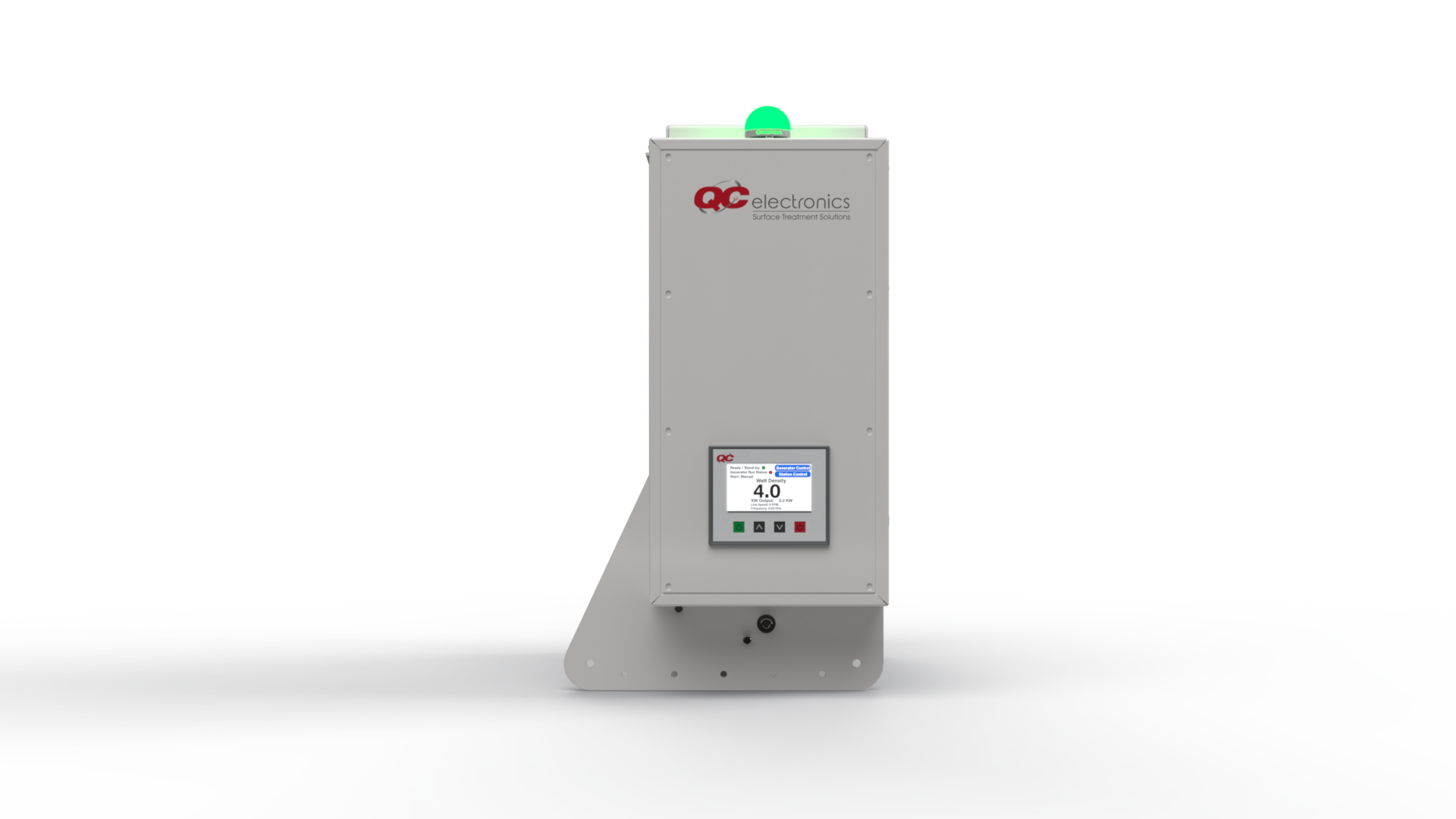
QC narrow web corona treaters are designed to integrate directly into your existing press—no modifications, no mechanical changes, no downtime for installation. Compact, high-power treatment positioned immediately before the print station ensures every substrate has the surface energy your ink demands, regardless of what arrived on the roll.

Zero press modifications: the treater drops into your existing press configuration. No custom brackets, no web path changes, no mechanical engineering required
Compact footprint: designed for the tight spaces inside narrow web presses where every inch of web path matters
Substrate flexibility: treats film facestocks, paper, synthetics, and metallized materials. Switch substrates between jobs without worrying about pre-treatment levels
Automatic watt density control: the NEXTGEN-i generator adjusts power proportionally to line speed, maintaining consistent treatment whether you’re running at setup speed or full production
The Safety Net for Narrow Web Printers

Even when your label stock arrives with acceptable dyne levels, an in-line corona treater acts as a safety net. Dyne levels don’t tell the whole story—additives, surface contamination, and storage conditions all affect adhesion in ways a dyne pen can’t measure.

Industry experts report that freshly treated material provides better adhesion than aged material at the same measured dyne level. A corona treater on your press ensures every job starts with a fresh, clean, fully activated surface, eliminating the guesswork that comes with relying on pre-treatment alone.

RESULTS

What Corona Treatment Delivers for Narrow Web Printers

Reliable Ink Adhesion

Every substrate gets freshly treated immediately before the print station — eliminating adhesion failures caused by decayed pre-treatment or inconsistent incoming dyne levels.

Better Print Quality

Proper surface energy ensures ink wets out evenly across the web. Sharper images, richer color density, and consistent coverage — even on difficult substrates like metallized films.

Less Downtime

Stop rejecting jobs because of adhesion problems. Stop re-running orders. Stop troubleshooting ink issues that trace back to surface energy. The treater handles it before the ink ever touches the substrate.

More Substrate Options

Take on jobs with substrates you couldn’t reliably print before. In-line treatment gives you the confidence to quote a wider range of materials — expanding your capabilities and your revenue.

OUR PROCESS

From Your Application to a Working Solution

01

Application Review

We gather details about your substrate, ink type, line speed, treat width, and production environment.

02

Lab Testing

Ship us your substrate. We run it through our treaters and measure dyne levels to determine optimal treatment parameters.

03

System Design

Our engineers configure a corona treater matched to your exact specs: application, substrate, treat width, power density, and mechanical integration.

04

Install & Support

Every system ships after a week-long QA test under load. We support installation and provide ongoing technical assistance.

EXPLORE OTHER APPLICATIONS

Printing & Labeling

Wide web flexo, gravure, and digital.

Coating & Laminating

Adhesive and extrusion coating.

Blown & Cast Film

Inline treatment at the extrusion line.

Research & Development

Lab-scale testing and validation.

Specialty & Custom

Medical, automotive, and unique substrates.

GET STARTED

Ready to Eliminate Ink Adhesion Problems on Your Press?

Tell us about your press, substrate mix, and ink chemistry. Our engineers will configure a narrow web corona treater that drops directly into your line—no modifications required.

Request a Custom Quote →