
coating
Home / Applications / Coating & Laminating
COATING & LAMINATING

Corona Treatment for Coating and Laminating Applications

Delamination, weak bonds, and inconsistent coat weights cost converters thousands in rejected product and lost production time. QC Electronics corona treaters deliver the precise surface energy your coatings and adhesives need to bond permanently, at any line speed.

Get a Quote → Talk to an Engineer
THE CHALLENGE

Why Coating and Laminating Require Corona Treatment

Coatings and adhesives need to wet out evenly and bond permanently to the substrate surface. When the surface energy of your film is too low, coatings bead up, adhesives fail to anchor, and multi-layer laminate structures delaminate under stress, sometimes days or weeks after production.

Untreated polyethylene has a surface energy of just 30 dynes/cm. Polypropylene sits at 29. Most adhesives and coatings require substrate surface energy of 38-44 dynes/cm or higher for reliable bonding. Without corona treatment, the gap between what your substrate offers and what your coating demands leads to bond failure.

The problem compounds in multi-layer structures. Every interface in a laminate is a potential failure point. If any single layer has inadequate surface energy, the entire structure is compromised, and you won’t always catch it until the product reaches your customer.

Common Substrate Surface Energy — Untreated (dynes/cm at 25°C)
Substrate
Untreated Surface Energy
Polyethylene (PE)
30
Polypropylene (PP/OPP)
29-30
Polyester (PET)
46-48
Nylon (PA)
46
Metallized Film
32-50+
Target treatment level depends on your coating or adhesive. The substrate surface energy must exceed the surface tension of your coating system by 8-10 dynes/cm. QC Electronics sizes every system to your specific chemistry, substrate, and line speed.
THE SOLUTION

Reliable Bond Strength at Every Interface

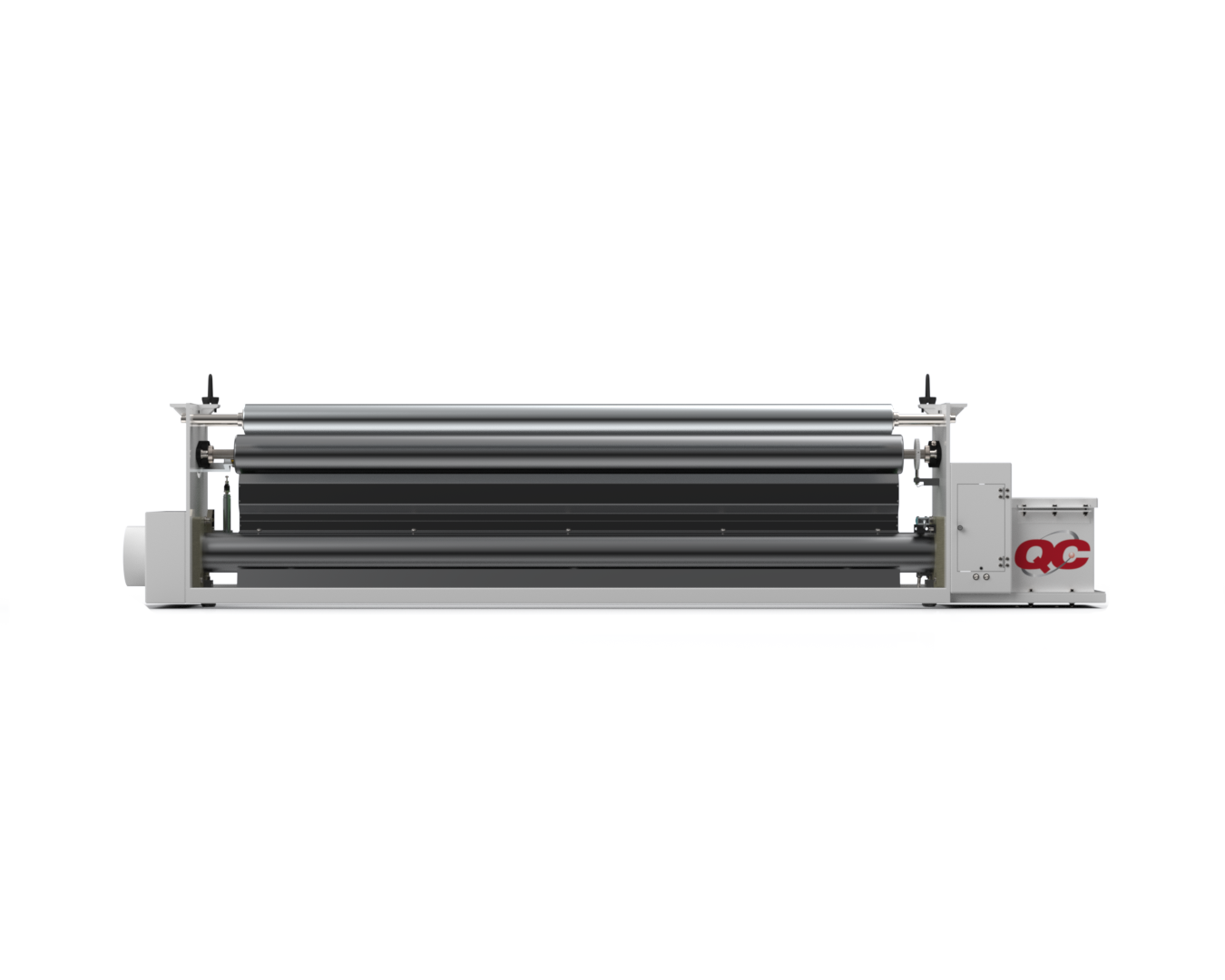
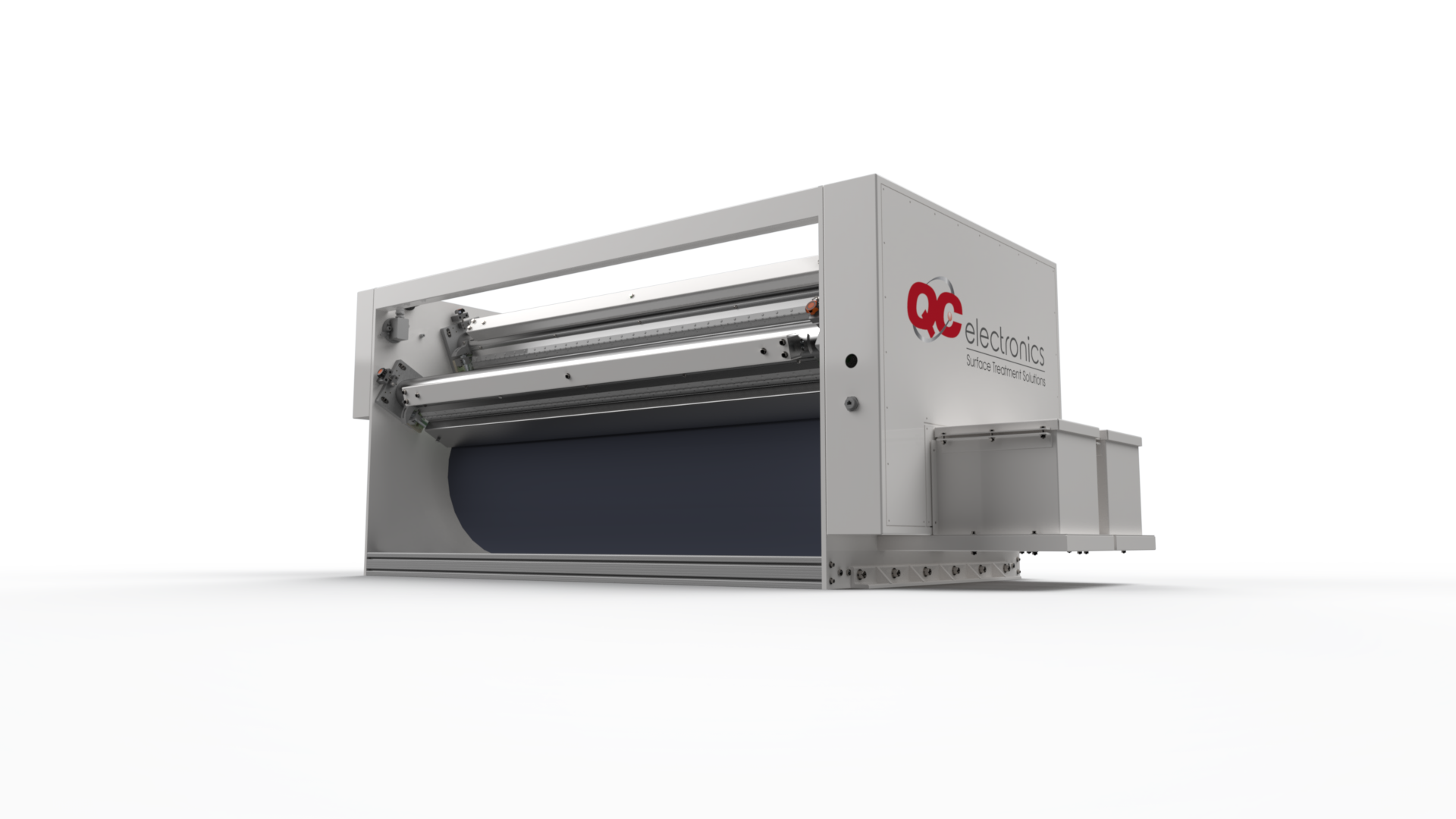
QC corona treaters raise the surface energy of your substrate to the exact level your coating or adhesive chemistry requires. Whether you’re running solvent-based adhesives, solventless systems, or extrusion coatings, we size the treatment to your specific process—not a generic recommendation.

Extrusion coating: molten polymer is applied directly to the substrate at high temperatures. Corona treatment ensures the extrudate bonds to the surface instead of peeling away after cooling.
Solvent-based adhesive laminating: requires substrate treatment to 40-44 dynes/cm for reliable wetting and bond development. Higher initial tack minimizes telescoping risk, but inadequate surface energy still leads to adhesion failures
Solventless laminating: adhesive surface tension is typically around 40 dynes/cm, requiring substrate treatment to 48-50 dynes/cm for best results. This is the highest treatment threshold of any laminating method, and at faster line speeds, the adhesive has even less time to wet out properly
Water-based coatings and adhesives: highest surface tension of any coating type. Requires maximum treatment levels and benefits significantly from in-line corona treatment to maintain surface energy at the point of application
Why In-Line Treatment Matters for Laminating

Corona treatment is reversible: surface energy begins to decay the moment treatment occurs. Slip agents migrate to the surface, environmental exposure reduces polar groups, and the treatment level you measured at the treater may not be what your adhesive sees at the laminating nip.

In-line corona treatment—positioned as close to the coating or laminating station as possible—ensures your substrate has maximum surface energy at the exact moment the adhesive or coating contacts the surface. This is why QC treaters are designed for seamless integration into existing converting lines.

RESULTS

What Corona Treatment Delivers for Coaters and Laminators

Stronger Bond Strength

Coatings and adhesives anchor permanently to treated surfaces. Eliminate delamination, peel failures, and weak seals that cause product recalls and customer complaints.

Consistent Coat Weight

Proper substrate wetting allows coatings to spread uniformly across the web. No beading, no bare spots, no edge pull-back, even at high line speeds.

Higher Line Speeds

Higher surface energy improves coating flow-out and reduces the time needed for adhesive wet-out. Converters have realized speed increases of 50-200 fpm with proper in-line corona treatment.

Reduced Waste

Eliminate rejected product caused by bond failures that don’t show up until quality testing or—worse—in the hands of your customer. Consistent treatment means consistent bonds.

OUR PROCESS

From Your Application to a Working Solution

01

Application Review

We gather details about your substrate, ink type, line speed, treat width, and production environment.

02

Lab Testing

Ship us your substrate. We run it through our treaters and measure dyne levels to determine optimal treatment parameters.

03

System Design

Our engineers configure a corona treater matched to your exact specs: application, substrate, treat width, power density, and mechanical integration.

04

Install & Support

Every system ships after a week-long QA test under load. We support installation and provide ongoing technical assistance.

EXPLORE OTHER APPLICATIONS

Printing & Labeling

Flexo, gravure, and digital printing.

Blown & Cast Film

Inline treatment at the extrusion line.

Narrow Web

Tag and label presses.

Research & Development

Lab-scale testing and validation.

Specialty & Custom

Unique substrates and applications.

GET STARTED

Ready to Solve Your Ink Adhesion Challenges?

Tell us about your printing process, substrate, and ink type. Our engineers will recommend the right corona treatment system and provide a detailed quote.

Request a Custom Quote →